Seascape
 Work Artirst Modal
Seascape
Oikonomou, Michalis (1884 Piraeus - 1933 Athens)
Having manifested his talent in painting from a very young age, he took his first painting courses in Piraeus, with Konstantinos Volanakis. In 1906, he went to Paris in order to study shipbuilding, but his contact with the artistic trends prevailing in the French capital at the time and his acquaintance with Periklis Vyzantios, Juan Gris and other painters, made him choose the School of Fine Arts instead.
He stayed in Paris until 1926 and he held his first solo show there, in 1913, at the Bernheim gallery. During the same time, he also participated in group exhibitions in the French capital, London and Athens. In Greece, he held his first solo show in 1926 at the Parnassos cultural society. He continued working and exhibiting his work in group exhibitions until 1933, when he died at Dromokaiteio. In 1961, a retrospective of his works was held the the gallery Armos.
The main focus of his work was landscape painting. Isolated houses at the edge of the sea, boats and small churches shrouded in a dreamlike, romantic atmosphere, were his most favorite subjects. His style is influenced by the paintings of Les Νabis and the Synthetists. In order to achieve the desired end result, he would not only use canvas or cardboard, but also undervests, old bedsheets, the glossy side of kitchen tarpaulin, even the waste rags he used for wiping off his brushes.
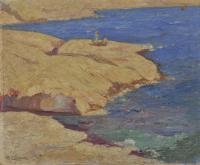

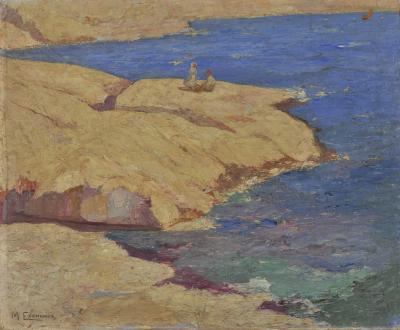
This work is not representative of the style of Michalis Oikonomou, who is increasingly favoring dull, hazy landscapes, reflections of the visible world in the water, landscapes of Brittany or Southern France, i.e. places that the painter systematically visits and paints. This “sun-happy” landscape is also dated to the painter’s early period. The sea and the human presence, so small that it is hardly discernible in the landscape, are Oikonomou’s great fixations. Water and land generate a discourse between the cool blue and the warm color of the sun, producing matières and textures, alternations and changes. With this work, Oikonomou conveys a salty sensation, the taste of life flowing by the sea, while the color of the ocean, extensively worked on, implies the presence of wind.
 WorkOfArt RelatedInfo
 ECard
- Χρονολογία: 1920 - 1926
- Υλικό: Λάδι σε χαρτόνι
- Διαστάσεις: 50,5 x 60,5 cm
- Αρ. Έργου: Π.2962

 Π.Ε.Π. ΙΟΝΙΩΝ ΝΗΣΩΝ