Sailor and Cupids (fan)
 Work Artirst Modal
Sailor and Cupids (fan)
Tsarouchis, Yannis (1910 Piraeus - 1989 Athens)
He studied at the Athens School of Fine Arts (1928-1934) with teachers such as Dimitrios Biskinis, Dimitrios Geraniotis, Spyros Vikatos, Georgios Iakovidis, Thomas Thomopoulos, Yiannis Kefallinos and Konstantinos Parthenis. At the same time, he trained for four years (1930-1934) at the studio of Photis Kontoglou, who introduced him to Byzantine painting and music.
In 1935 he travelled to Istanbul and Izmir and later to Paris, where he was taught the technique of engraving/printmaking. In the French capital, he became acquainted with Renaissance painting, Impressionism and the work of Theophilos through the collection of Tériade . In addition, he met Matisse, Laurens and Giacometti. In 1936 he returned to Greece and, two years later, he organized his first solo exhibition at the shop of Th. Alexopoulos in Athens. This was followed by many more solo shows, including, among others, the retrospectives at the British Council (1952), gallery Astor (1966) and the Archaeological Museum of Thessaloniki (1981). In 1980, a Yannis Tsarouchis solo show was organized at the Grand Palais in Paris. His exhibition activity also includes appearances in the exhibitions of the group “Armos”, of which he was a founding member, as well as in Panhellenic and international exhibitions, such as the Biennales of Alexandria in 1955 and Venice in 1958.
In 1928 he started his professional activity in set design, which covers a significant part of his artistic creation, including cooperations with the Greek National Theater, the Greek National Opera, the Greek Art Theater of Karolos Koun, the Ancient Theater of Epidaurus, the Covent Garden in London, the Dallas Civic Opera in Texas, the Theatre National Populaire in Paris and the Teatro Olympico in Vincenza. He cooperated with major Greek and foreign artists, such as Maria Callas, Katina Paxinou, Alexis Minotis, Michael Cacoyannis, Jules Dassin and Franco Zeffirelli. During the years 1960-1962 he taught set design at the Doxiadis School. At the same time, he was also active in book illustration, while, in the context of his broader interest in art, he also wrote texts and reviews, which were later published in books.
In 1967, due to the political circumstances in Greece, he went back to Paris, from where he was to return for good in 1980. Two years later the “Yannis Tsarouchis Foundation” (www.tsarouchis.gr) was inaugurated in the artist’s house in Maroussi, containing both his works and those of other artists. One of the principal representatives of the “Generation of the ’30s”, Tsarouchis incarnated the ideal of “Greekness” in his work. Tapping on a plethora of influences, from Hellenistic and Byzantine art to Renaissance and modern art, from the work of Matisse, Theophilos and Kontoglou to the shadow puppets of Karaghiozis, he shaped a unique personal style, depicting landscapes, still lifes, nudes and allegorical scenes. Yet, his primary interest was focused on the human form. Thus, a most typical part of his oeuvre is comprise of isolated portraits and composite scenes featuring sailors and soldiers.
A particularly enlightening publication in terms of accurately retracing his artistic journey is Yannis Tsarouchis - Painting (1990, edition of the Yannis Tsarouchis Foundation), most of it curated by the artist himself, in cooperation with Niki Grypari. In addition, one of the most notable posthumous attempts to approach his work was the exhibition “Yannis Tsarouchis. Between East and West. Selections from the Collection of the Yannis Tsarouchis Foundation” (curator: Anna Kafetsi, National Museum of Contemporary Art, 24/2-3/6/2000).
A retrospestive exhibition of his work was inaugurated in December 2009 at the Benaki Museum.
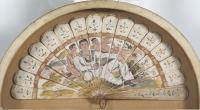


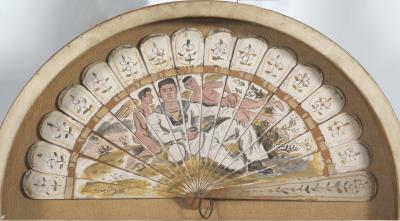
In this fan, Tsarouchis incorporates all his great loves, which characterize his entire work. The sailor, a symbol of masculine beauty and strength, as well as a condensed paradigm of the Greek ideal of masculinity, is resting in a relaxed setting, accompanied by cupids. This is one of the typical images that are repeated throughout the oeuvre of Tsarouchis. The cupids, a reference to Greek Antiquity, as well as the European painting tradition, are transformed in Tsarouchis’s personal mythology into robust young men who fly, contemplate and befriend melancholic sailors. The painting of Tsarouchis, an idiom imbued with his study of European modernism, Byzantine art and classical Greek art, is characterized by both simplicity of script and a unique interpretation of everyday life, one that exalts solitariness and the individual’s reconciliation with the natural landscape.
Space, real space, becomes a big stage where Tsarouchis the painter coexists seamlessly with Tsarouchis the set designer and director. The fan is apparently an accessory to one of his favorite theatrical costumes, which he enjoyed showcasing in the company of his friends.
 WorkOfArt RelatedInfo
 ECard
- Χρονολογία: 1943
- Υλικό: Τέμπερα σε ξύλο
- Διαστάσεις: 16 x 32 cm
- Αρ. Έργου: Π.5835

 Π.Ε.Π. ΙΟΝΙΩΝ ΝΗΣΩΝ