The Little Donkey
 Work Artirst Modal
The Little Donkey
Lytras, Nikos (1883 Athens - 1927 Athens)
He studied at the School of the Arts (1902-1906), taught by his father, Nikiforos Lytras, and Georgios Iakovidis. Starting in 1907, he continued his studies at the Academy of Munich, with teacher Ludwig von Löfftz. While in the Bavarian capital, he came in contact with German Expressionism and the creations of the group “Blaue Reiter”. After his return to Athens, in 1912, he began to participate in the exhibitions of the Union of Greek Artists (1915, 1916, 1917, 1920, 1926), and in 1919 he exhibited jointly with sculptor Grigorios Zevgolis. He was a founding member of the art group “Omada Techni”. In 1923 he was elected professor at the Athens School of Fine Arts. After his death, retrospective exhibitions of his work were held at the Zappeion in 1929 and the Venice Biennale in 1936.
Nikos Lytras, together with Konstantinos Parthenis and Konstantinos Maleas, are jointly considered as the “regenerators” of modern Greek art in the early 20th century. Nikos Lytras influenced the development of Greek painting through both his teaching at the Athens School of Fine Arts and his pioneering work. His portraits, landscapes and still lifes are constructed through broad free brushstrokes of thick color applied in a gestural manner.
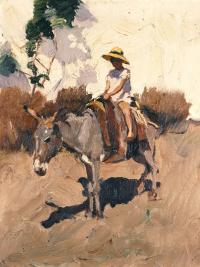

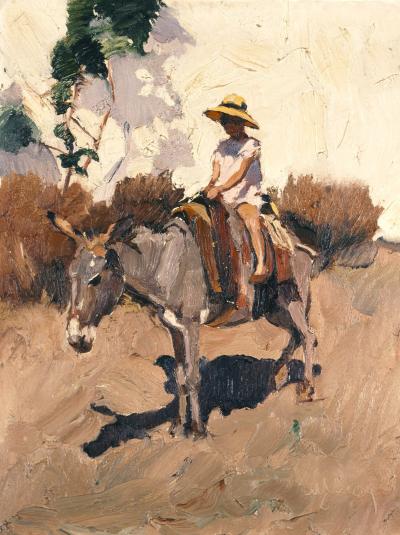
“I also work on themes of the outdoors, compositions in light and sun,” the painter used to say. This midday scene that Lytras chooses to immobilize in time is set in his place of origin, the island of Tinos. The relief strokes, the sensual painting, provoke the eye to reach out and run its gaze throughout the work, to feel the different densities and intensities between shadow and light. The brushstrokes, the play of light and the touch of shadow on the surfaces appear to be shifting over the child, the foliage of the tree, the shadows on the wall and on the ground.
The Little Donkey is one of the works displayed since day one of the permanent exhibition of the Corfu Branch, a reference to the oh-so-familiar images from the countryside of Corfu, scenes that have now been forever lost.
 WorkOfArt RelatedInfo
 ECard
- Χρονολογία: 1923 - 1926
- Υλικό: Λάδι σε μουσαμά
- Διαστάσεις: 88,7 x 66,2 cm
- Αρ. Έργου: Π.1863

 Π.Ε.Π. ΙΟΝΙΩΝ ΝΗΣΩΝ