Annunciation
 Work Artirst Modal
Annunciation
Parthenis, Konstantinos (1878/1879 Alexandria - 1967 Athens)
He most likely received his first painting lessons in Egypt during 1894-1895, taught by the German artist Karl Wilhelm Diefenbach. He then went on to Vienna in 1895/1896, where he completed his studies at the Academy of Fine Arts (1897-1903) and at the Conservatory.
In 1903 he came to Greece for the first time and, in that same year, he took part in the International Exhibition in Athens, in which he was awarded a silver medal. He stayed in Greece for five years, during which he travelled to various places, painting secular and religious themes for churches. From 1909 to 1911/1914 he lived in Paris, where he took part in several Salons, including the 1910 Autumn Salon, where his work “The Slope” was awarded a prize. Upon returning to Greece, he settled in Corfu for some time, acquired the Greek citizenship and became a member of the literary and artistic group “Company of Nine”. In 1917, he permanently relocated to Athens and co-founded, together with other artists, the art group “Omada Techni”. In 1929, a presidential decree issued by his close friend Alexandros Papanastasiou appointed him professor at the faculty of the Athens School of Fine Arts, after he had failed to be elected professor in 1923. He taught at the School until 1947, at which point he resigned. His paintings include religious themes, landscapes, mythological and allegorical scenes, portraits and still lifes. His inspiration is drawn from the ancient and Byzantine art, as well as the latest trends – impressionism, post-impressionism, symbolism and Art Nouveau – thus paving the way for the renewal of Greek art.


Religious painting was a field that Konstantinos Parthenis began to explore as early as his years in Vienna, during which he completed five icons for the Orthodox cathedral of Saint George. The painter resumed Byzantine religious painting from August to November 1904, when he toured around Macedonia and Istanbul and accepted orders for portable icons, but mainly from late 1906 to March 1907, when he lived in Poros and painted the cupola and portable icons for Saint George.
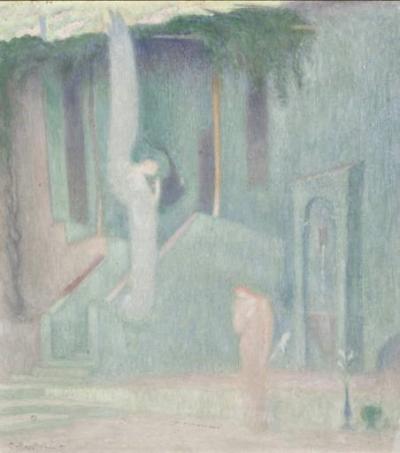
The first, small-sized, version of his work Annunciation is dated between 1907 and 1910 and features a scene set in front of the fountain of the Life-Receiving Spring Monastery (Moni Zoodochou Pigis) in Poros. During 1910–11 the painter worked on five different versions of this icon, all dominated by the color blue—two of these are also gilded—while the icon on display in Corfu is dominated by the color green. The theme is the same: the angel is hovering in front of the Virgin Mary holding a lyre in his hand. In keeping with Viennese and French symbolism, the painter bestows on this religious event due devoutness and a sacramental atmosphere.
 WorkOfArt RelatedInfo
 ECard
- Υλικό: Λάδι σε μουσαμά
- Διαστάσεις: 35 x 32 cm
- Αρ. Έργου: Π.6498

 Π.Ε.Π. ΙΟΝΙΩΝ ΝΗΣΩΝ